
Building the Future: Secure, Fast & AI-Powered Software

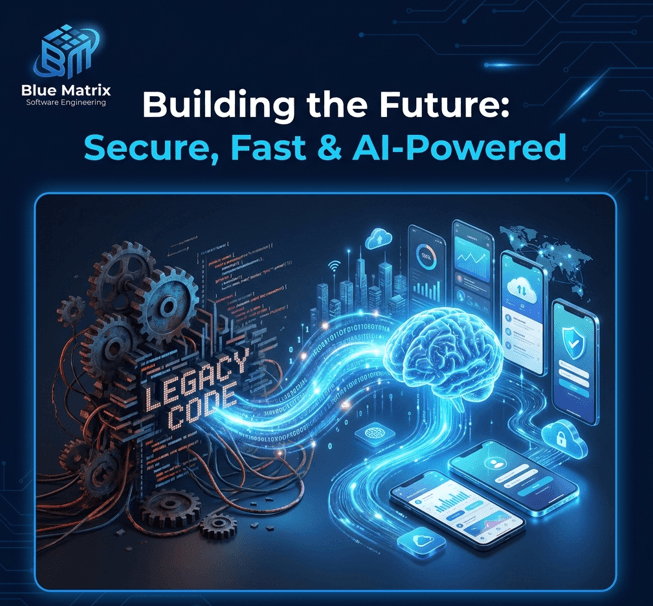
I have been working as a software engineer at Blue Matrix for a year and a half now. During my time at Blue Matrix, I have worked on many web development, mobile app development, and software engineering projects. I use modern frameworks like .NET Core, Next.js, Flutter, and tools like Prisma ORM.
Across all my work, I always try to follow good software engineering practices. This means writing clean code, keeping files organized, making secure databases, and solving hard technical problems in simple, clean ways. In this blog post, I want to share my experience working on our major projects like Flipteria and our mobile travel application.
Fixing Security and Building Flipteria with .NET Core and Next.js
My very first big assignment at Blue Matrix started right after I joined the company. Within my first six months, I was asked to help rebuild our major e-commerce website called Flipteria. The old Flipteria website had major security problems because it used outdated coding styles and old login systems. This made the website unsafe for users and shoppers. After my team and I discussed the security risks together, we all agreed that we needed a brand-new security system.
I worked on .NET and .NET Core on the backend to create a completely new profile-based and role-based login system. Role-based access control means that regular customers, store managers, and site admins only see and touch the things they are allowed to see. I wrote this authorization system from scratch to make sure all legacy security bugs were completely removed. On the frontend, we used Next.js to make the website fast and easy to navigate. We also used Microsoft SQL Server to talk to our SQL database safely. Using Microsoft SQL Server helps prevent dangerous SQL injection attacks and makes our database code simple and clean. After fixing the website, I also worked on the mobile app version of Flipteria using Flutter. This made sure that people shopping on their phones had the exact same smooth, safe, and reliable experience as people using a computer browser.
Building a Smart AI Favorites Feature for a Mobile Travel App
After working on Flipteria, another major project I worked on was a mobile travel app built with Flutter. Mobile apps usually search for places using very simple rules. For example, if you want to find a hotel, a standard app runs a basic database query using fixed filters like city name or price range. But standard database search filters are boring and limited. They only show plain results and cannot guess what a user really likes.
I wanted to make this travel app much better, so I built an AI-Powered Favorites and Suggestion System. Instead of using standard database filters, my system uses artificial intelligence to look at user behavior, user choices, and real-time app interactions. The AI learns what kind of trips a user prefers and automatically suggests great destinations for them.
"The hardest engineering problem I faced while building this AI feature was keeping the AI token count low while getting the best results. Every time an AI model reads data, it uses tokens, which cost money and take computer processing time."
— Software Engineering Insights , AI Token Optimization
To solve this challenge, I spent a lot of time organizing the input data, simplifying prompt structures, and writing efficient code. This allowed the AI engine to give fast, hyper-personalized trip suggestions to travelers while using very small amounts of tokens. This kept API costs low and kept the app running fast.
Good Software Engineering Practices and Working Across Other Projects
Besides working on the Flipteria web platform, the Flipteria Flutter app, and the AI travel app, I have also worked on several other .NET and Next.js web projects at Blue Matrix. Across all these projects, my goal as an experienced software engineer is always to apply simple, clean, and reliable coding standards that diploma students and junior developers can easily understand and maintain.
- .NET Core for Backend Systems: Allows us to build strong, enterprise-grade safety rules that protect client data.
- Next.js for Web Development: Helps us load pages fast and stay visible on search engines like Google.
- Prisma ORM: Gives us type safety in JavaScript and TypeScript code, catching mistakes before production launch.
- Flutter for Mobile Apps: Allows us to build Android and iOS mobile applications from one single codebase, saving time and effort.
What I Learned at Blue Matrix and What Comes Next
My past 1.5 years at Blue Matrix have been very rewarding. Combining my 4 years of software engineering experience with modern tools has helped our company transition away from old, risky legacy code to smart, modern software architectures.
Moving from simple, reactive software to smart, context-aware AI tools is the future of software development. By building secure logic systems in .NET Core, using Prisma ORM with Next.js, writing cross-platform apps in Flutter, and optimizing AI prompts for low token usage, we can deliver high-value web and mobile platforms. At Blue Matrix, we will keep working hard to build software that is secure, fast, smart, and easy for everyone to use every day.